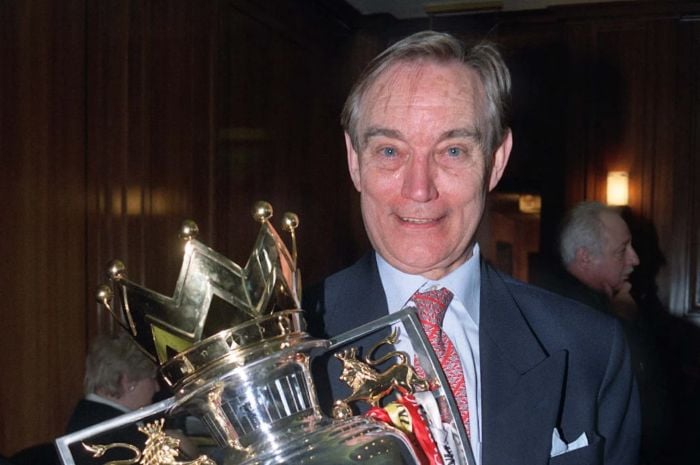
Ken Friar, an Officer of the Order of the British Empire (OBE), devoted almost his entire life to Arsenal. His connection with the club spanned nine decades: from 1946 to 2020, his work in north London became legendary.
In his memory, the club’s official website has recalled just how much Ken changed and influenced the history of the football club.
A chance encounter
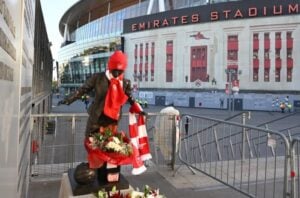
“I want to dispel one rumour straight away: I wasn’t here in 1886,” Ken once joked. His connection with Arsenal came about entirely by chance. In post-war London in 1946, a young and energetic Ken Friar retrieved a football from underneath a car on Avenell Road, right outside the famous Marble Halls at Highbury. The car belonged to our manager, George Allison, and, impressed by Ken’s energy, he offered him a job the very next day, delivering letters for half a crown a week. Ken’s enthusiasm for Arsenal never left him, and in 1950 he was given a permanent position at the club. If a chance encounter were ever to be commemorated, this would be the one. Fortunately, the moment has been immortalised in bronze outside the Emirates Stadium.
Helping the heroes
Throughout his long career at the club, Ken stood up for many important values. One of the best examples came in the 1980s, when the team led by Ken helped secure fair payments for veteran players who had served in the Second World War. In 2012, Ken recalled: “In 1939, players who went off to war were given bonuses of £500, which was a huge amount of money in those days. These bonuses were supposed to be returned to the club as loans at 2% interest, so in effect, they never actually received the money.”
“This came to light in the early 1980s. The chairman found out about it, and I was asked to go back and track down as many of those former players as possible. We then gathered the money and paid it to them some 40 years later. That is one real example of the values we strive to live by.”
A European adventure
During his time working under club secretary Bob Wall, Mr Friar learned about every aspect of the team’s operations. One of Ken’s responsibilities was helping to organise our first-ever European campaign in the 1963/64 season, in the Inter-Cities Fairs Cup. Although we had played abroad before, this was our first official away fixture. In the first round in September 1963, we were drawn against Copenhagen XI, and Ken organised the trip to Denmark, where we secured a 9-4 aggregate victory. It marked the beginning of our long history in European competitions.
Boxing
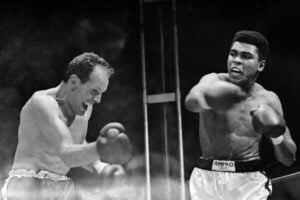
Ken became Wall’s assistant secretary in 1965 and, during that period, played a key role in bringing a completely different sport to Highbury. On 21 May 1966, our old stadium hosted a world heavyweight title fight between Muhammad Ali and Henry Cooper, attended by more than 46,000 spectators. Ken was immensely proud of organising the event. “That fight was probably one of the most memorable nights of my life. It was an incredible evening, the weather was fantastic and everyone was there,” he recalled. “I met Ali – I was very lucky. He was amazing, quite simply. He had incredible charisma, and everything about him radiated greatness.”
Safety first
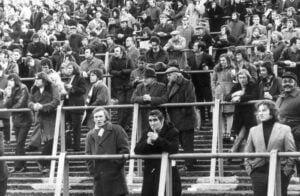
In the 1970s, when football hooliganism was rife, many people called for fences to be installed in front of the stands at Highbury. But Ken resisted, fighting hard to ensure that nothing of the sort would appear at our legendary stadium. He was also one of the leading opponents of introducing identity cards for supporters, noting: “If you treat fans like animals, they will behave accordingly.”
A constant presence
Football was changing rapidly. In February 1983, Ken became managing director, a position he held until 2000, as unprecedented amounts of money began flowing into the game. While many clubs were going through a period of upheaval, Ken’s steady hand and consistency allowed us to continue developing without losing our way. During his time in the role, he helped transform Highbury into an all-seater stadium and played an active part in contract negotiations with managers and players. During this period, he was involved in the appointment of George Graham, who subsequently helped us win our first league title in 18 years at Anfield in 1989. He also played a part in the creation of the Premier League and in bringing Arsène Wenger to our club in 1996.
The Emirates
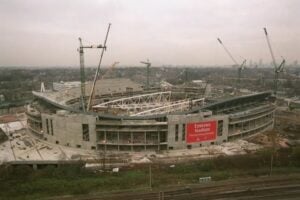
Ken had long understood that the club would eventually have to leave the old Highbury ground and move to a modern stadium. “We knew we needed a bigger stadium,” he recalled in 2011. “It was an emotional time for everyone, perhaps even more so for me because I had spent my entire life in that building. It was clear that we would not be able to compete with the biggest clubs without a new stadium. It transformed our business overnight.”
Alongside fellow director and longtime friend Danny Fiszman, Ken was tasked with finding a new site for the stadium in 2000. He played a pivotal role in the eventual move in 2006, ensuring that all the necessary conditions were met and finding a way to keep the club in Islington. Put simply, without Ken Friar, there would be no Emirates Stadium today.
Tradition
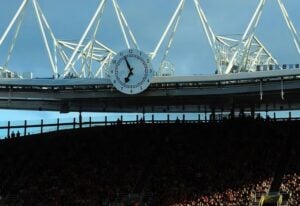
Ken Friar’s office was like a little piece of Arsenal history. It was filled with newspaper cuttings dating back to the 1890s. Ken had a desk that once belonged to former manager Herbert Chapman and made sure that our identity was never lost in a changing world. He also played a key role in moving our famous clock from Highbury to its new home. In 2011, he told The Telegraph: “I have always felt that people like me are custodians of our heritage. I genuinely believe it needs to be protected. It took 125 years to create what we have, but if it is handled incorrectly, it can be destroyed in 10 minutes. This club is like your health: you don’t appreciate it until you lose it. Nine out of every ten people who leave our stadium want to come back.”
Ken remained true to these values, and his dedication earned him the title of Honorary Freeman of the Borough of Islington in 2004, four years after he was awarded the OBE in 2000 for his services to football.
A royal Arsenal
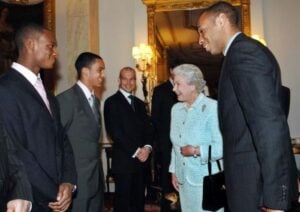
Few football clubs in Britain have welcomed members of the Royal Family, but thanks to Ken’s connections, it became possible for Arsenal. His work with the Royal Household helped arrange Queen Elizabeth II’s presence at the official opening of the Emirates Stadium. However, the Queen was unable to attend the ceremony due to illness and was represented by the Duke of Edinburgh. Ken later arranged for the men’s first team to visit Buckingham Palace and meet her. Speaking about his connection with Queen Elizabeth in 2022, he said: “We were thrilled that she accepted our invitation to open the stadium in 2006, but ill health prevented her from joining us on our special day. It was therefore wonderful that just a few months later she invited the players and staff to Buckingham Palace, fulfilling her promise to mark a key moment in our history.”
Between eras
Few people can claim to have met the legends of Herbert Chapman’s team, celebrated the 1971 champions’ triumph in the dressing room at White Hart Lane and watched Bukayo Saka lift the FA Cup above his head. But Mr Friar could. “He was the first to arrive at the stadium and the last to leave,” Arsène Wenger recalled in 2011. Friar eventually stepped down from the board in 2020 after more than 70 years of service.
“He was Mr Arsenal,” club legend Charlie George said in tribute to Ken. “Tomorrow’s match is always the most important one,” Ken used to say, and nobody embodied our motto, “Forward”, quite like him. In recognition of Mr Friar’s hard work and dedication, the north bridge leading to the Emirates Stadium was named in his honour.
Source www.arsenal.com
Author: MissingHenry